
What IIoT Actually Means on a Shop Floor

The Industrial Internet of Things (IIoT) is not a single product you buy. It is a layer of sensors, edge devices, and software that connects your machines to a network so you can collect and act on production data in real time. On a CNC shop floor, that might mean a vibration sensor on a spindle, a current clamp on a servo motor, or a simple cycle counter wired to the machine’s relay output.
The connectivity side has settled on a few standards. OPC UA is the most common protocol for reading data from modern CNC controllers (Fanuc, Siemens, and Heidenhain all support it). MTConnect is an open, read-only alternative popular in North American shops. For older machines without a network port, an edge gateway with digital I/O can still capture cycle start/stop signals, spindle on/off, and alarm states without any modifications to the controller itself.
The Data That Actually Matters
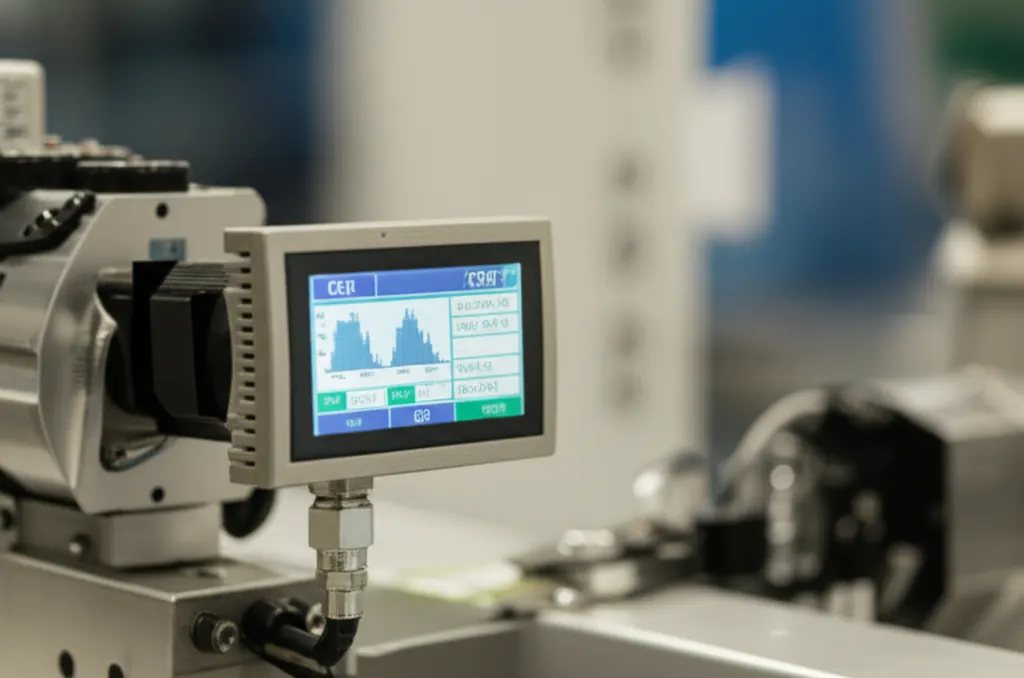
Shops that succeed with IIoT focus on a small set of signals first, rather than trying to capture everything at once:
- Cycle counts and cycle time tell you how many parts a machine actually produced per shift and whether cycle times are drifting upward, which is a sign of tool wear or program issues.
- Spindle load and servo current reveal cutting forces in real time. A sudden spike can mean a broken tool; a gradual climb means the tool is wearing and parts may be approaching tolerance limits.
- Alarms and downtime events show where time disappears. Most shops are surprised to learn that their bottleneck machine runs only 50 to 65 percent of available hours once setup, tool changes, and unplanned stops are counted.
- Tool life counters let you replace cutters on schedule instead of after they produce a bad part.
- Temperature and humidity in the quality lab matter because CMM measurements shift with ambient conditions. A simple networked sensor logging lab temperature every minute gives your inspection data a verifiable environmental context.
How IIoT Feeds Quality
The real payoff for a quality manager is traceability. When machine data is timestamped and linked to production batches, you can answer questions that used to require detective work: which machine made a suspect part, what the spindle load looked like during that run, and whether the tool was near end of life.
More importantly, you can react to drift before parts go out of tolerance. If your monitoring system flags that cycle time on a turning operation climbed by eight percent over the last 200 parts, that is a signal to check tool condition and measure the next part before the whole batch is scrap. This is not predictive maintenance in the AI sense. It is straightforward threshold monitoring, and it works.
Traceability also simplifies audits. When a customer asks "show me the conditions under which lot 4471 was produced," you can pull machine state, operator, tool data, and inspection results from the same time window instead of cross-referencing paper logs.
Getting Started: Realistic First Steps for a Small Shop
You do not need to instrument every machine on day one. A practical starting point:
- Pick your bottleneck machines (usually two or three). Install cycle counters and downtime tracking on those first. This alone gives you an accurate OEE baseline.
- Use what the controller already offers. Many modern CNCs expose data over Ethernet natively. An OPC UA client or MTConnect agent running on a small industrial PC can start logging without any hardware modifications to the machine.
- Set up a simple dashboard that shows today’s cycle count versus target and current machine state (running, idle, alarm). Operators respond to visible information.
- Connect downtime categories to reasons. "Machine idle" is not actionable. "Waiting for material" or "tool change" is.
Once the bottleneck machines are producing reliable data, expand to the next group. This incremental approach keeps costs controlled and gives your team time to learn what the data actually tells them.
Pitfalls to Watch For
IIoT projects fail more often from organizational issues than from technology problems. The most common pitfalls:
Data nobody looks at. Collecting data is easy. Building the habit of reviewing it daily and acting on what it shows takes deliberate effort from management. If no one checks the dashboard, the sensors are wasted money.
Integration cost surprises. The sensor itself may be inexpensive, but connecting it to your ERP, MES, or quality system can require custom middleware. Budget for integration work, not just hardware.
Security of networked machines. A CNC connected to the shop network is a device that needs basic protections: VLAN segmentation, no direct internet exposure, and firmware updates when the controller manufacturer releases them. This does not require a large IT team, but it does require someone thinking about it before the machines go online.
Connecting Machine Data and Quality Data
IIoT gives you the machine side of the picture. But machines produce parts, and parts need inspection. The full loop closes when your machine data and your quality data describe the same production batches.
QA Report handles the quality side of that loop. Batches and route cards track each production lot through the shop floor, recording which operations were performed and by whom. Inspection results, including dimensional and GD&T measurements, are stored per batch. Stock quantities update as batches complete. When your IIoT system captures machine conditions during a run and QA Report captures the inspection outcome of that same batch, you have end-to-end traceability from raw material to shipped part, without paper.
That connection is what turns raw sensor data into something a quality manager can act on. The machine told you what happened during production. The inspection report tells you what the part looks like. Together, they answer the only question that matters: are we making good parts, and can we prove it?