 QA Report


Every shop that runs a CMM eventually asks the same question: do we need another one, or do we need to use this one better? The answer depends on your part mix, your inspection workload, and whether the machine itself is truly the bottleneck.
Start with the numbers you already have. Count the distinct parts you inspect per shift, the number of features (dimensions, GD&T callouts) on each part, and the cycle time for each program. Then add the time that never shows up in the program file: loading and unloading the part, aligning it, swapping fixtures, and waiting for an operator.
A useful formula: take the available CMM hours per shift (typically 7 to 7.5 after startup and shutdown), then divide by the average total cycle per part (program run time plus load, unload, and fixture swap). The result is your theoretical maximum parts per shift. Compare that against the parts you actually need to inspect based on your sampling plan, such as every first article plus one in-process check for every 10 or 20 pieces.
Suppose your CMM is available for 7.5 hours per shift. The average part program runs for 12 minutes, and loading, probing setup, and unloading adds another 6 minutes, giving a total cycle of about 18 minutes per part. That allows roughly 25 inspections per shift at full utilization.
Now suppose you run two shifts and your sampling plan calls for a first-article inspection on each setup plus every 10th part from a typical run of 200 pieces. That works out to about 22 inspections per shift. At 88% utilization you have almost no room for program development, re-runs after probe crashes, or rush jobs from the floor. (These are hypothetical numbers for illustration, but the arithmetic works the same way in any shop.)
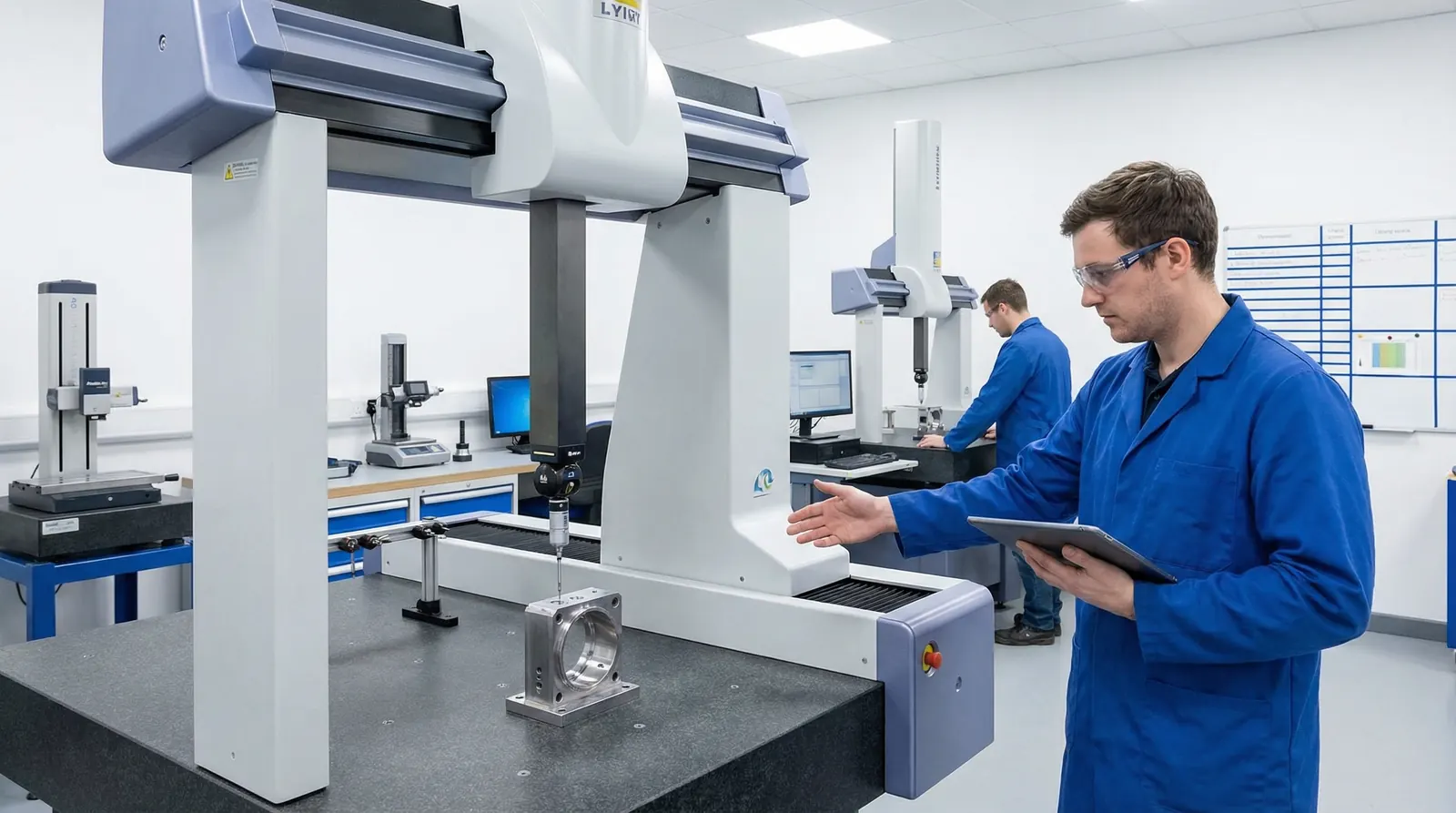
Most facilities start with a single CMM in a climate-controlled quality lab. It handles first-article inspections, customer returns, and anything that demands traceable accuracy. The problem is location: when the CMM sits at the far end of the building, operators lose time walking parts back and forth, and the queue grows faster than the machine can clear it.
Shop-floor CMMs or portable measuring arms placed near the machines give operators immediate feedback. They are not a replacement for the lab machine (vibration and temperature swings limit their uncertainty budgets), but they handle the high-volume in-process checks that clog the lab queue. Splitting the workload this way often does more for throughput than adding a second lab-grade machine.
Before writing a capital request, check whether your existing machine is actually the constraint. Four areas to look at first:
If utilization stays above 85% after those improvements, a second machine is justified. If the bottleneck turns out to be reporting or fixture changeovers, buying another CMM just gives you two machines with the same problem.
Not every dimension needs a CMM. Matching the measurement method to the tolerance saves time and frees the machine for the work only it can do.
Moving simple checks off the CMM can cut its queue significantly without any capital spend.
The purchase price of a CMM is only the beginning. Plan for these recurring expenses before you commit:
These costs recur every year. A machine that sits idle 40% of the time is not free spare capacity; it is wasted overhead.
One bottleneck that is easy to overlook is what happens after the CMM finishes measuring. If your operator copies numbers from a printout into a spreadsheet and formats a report by hand, that process can take as long as the inspection itself.
QA Report's CMM inspection software lets you import result files directly from your CMM into a structured inspection report, complete with tolerance evaluation, pass/fail status, and balloon references tied to the drawing. Parts move through a kanban board so everyone on the floor can see what has been inspected, what passed, and what needs rework. That means less time on paperwork and more time with the stylus on the part.
Start with the capacity math, fix the process bottlenecks you can fix for free, and only then decide whether another machine is the right investment.
Import CMM results directly into inspection reports and track part status on a kanban board.
Try QA Report FreeThe answer to "how many CMMs do we need" is almost never a single number. It depends on your part mix, your sampling plan, how well your fixturing and programming workflows support the machine, and whether every dimension really needs a CMM in the first place. Run the capacity estimate, address the bottlenecks that cost nothing to fix, and let the numbers tell you whether a second machine is the right next step.